Thursday, June 9, 2011

Double cooked slices of Roast Beef with an Onion and 'Tater Gravy

27th May 2011

My old Friend Jubal and his sister Gia came down to Kharghar to spend a couple of days with us. In true old style she brought something with her - Roast Beef the way her grandma made it!


Whilst Jubal and I did our best to gently imbibe some single malt (a 10yr old Ardbeg) Gia whizzed into our kitchen and soon made some superb sliced roast beef for us to nibble on with our booze.


Gia and Jubal


Gia slicing one of the two roasts to her spec


Gia slow frying the slices till they are almost charred ... slowly bringing out all the flavours.

*

8th  June 2011 

Inspired by her craftsmanship I decided yesterday to do the other roast in the other manner she had recommended ... she recommended cooking thick cut onions with potatoes in the leftover gravy before re-introducing the roast beef sliced slightly thick.


So I sliced up the onions and ecided to go with sliced rounds of the taters (for max flavour absorption), sliced the Beef and then put the gravy to heat with some water and the onions, and a good dash of freshly crushed pepper and half teaspoon of salt, on a very low flame.


When the onions had been in for 15 minutes i added the taters and let it cook for a further 15 minutes.


We served the the gravy with the onions and potatoes as a sauce with a  gorgeous Onion and Sundried Tomato Bread Plait from Chef Raunak at Potpourri (Vashi).


Needless to say it was superb ..... Thank u Gia!!


Gia Fernandes ... Baker and Confectioner Extraordinaire and Goddess of Roast Beef.

Saturday, June 4, 2011

Coorgi dinner in the bylanes of Bandora (old Bandra) village: One of the best meals I've eaten this year

Went out last night to try something new .... an exclusive dinner, specialised menu, small 'elite' crowd and absolutely homely setting.

Thanx to Rushina and her FB links one came across a very interesting group called CORAL ... who advertise the concept called a 'networking dinner'. 

What leapt straight out of the page were the word Pandi Curry - for the uninitiated it is the very pinnacle of southern Indian pork dishes and is a speciality of the Coorg (Kodagu) Hills in tamil Nadu and bordering on the eastern edges of Kerala. The Coorgis are a proud martial race and are known as much for their hospitality to friends as their implacable hostility to foes. One of India's only two field-marshal's, Cariappa, was a Coorgi! 

Their cuisine is quite unlike any other part of the South of India and the autochthons of Coorg - the Kodavas are famous (or infamous) for their passion for meat and liquor. The food is an amazing blend of local tribal traditions with influences from the neighbouring regions of Tamil Nadu and Kerala and the subtle influence of Manglorean Christian refugees and Muslims traders that came from the Keralite coast.

Their most well known and perhaps most popular dish is Pandi Curry a pork preparation that uniquely identifies them. It is a spicy albeit not fiery slow cooked preparation that is made for all weddings and other auspicious occasions. Its secret though lies in a special souring agent called kachampuli which is seldom available outside Coorg and is carefully couriered to the diaspora by hand. It is a unique fruit based souring syrup which whilst following the raison d'etre  of its other cousins like tamarind and kokum deviates by not just changing flavour but also add an unmistakeable texture to the dish.  It is usually served with an unleavened  rice bread made by mixing cooked rice paste with dry rice flour and is known as Akki-roti. 


Our host and chef Megha had made the Pandi Curry with the authentic Akki-roti which she made after we got there. All of us (Rushina, Rhea and I) crowded around and made a general nuisance of ourselves in her kitchen. 

We, Rhea and I, arrived in Bandra earlier than expected and spent two happy hours driving down streets that we had played and ploughed through in our childhood, Rhea's family lived in Bandra and it was my maternal grandparents home - where I spent most of my holidays. I keep wondering whether we ever passed one another in those days without the slightest inkling that we'd meet up in College and the fall in love in Pune!


It poured in Bandra and we had a lovely time driving around (including a short recce to confirm the address). We arrived at Pawan and Megha's at 9.15 and they were quite surprised that we had found thier place which is nestled deep inside the little gallis of Bandra village. Rushina arrived a few minutes later and pawan went off to the main road to fetch her. 

We had a little wine and some gorgeous tiny murukkus and some Superb pepper Chicken as starters, the chicken was interspersed with crunch kadipatta leaves that exploded flavour in the mouth.


We were soon fed an amazing meal of the BEST Pandi Curry (with akki-roti) I have ever eaten followed by a very interesting preparation of gauti (free range) chicken called Nati Kori (which translates as scrawny chicken) with rice. As though this gastronomic event wasn't enough Megha topped it off with some absolutely mind numbing fantastic dessert made with bananas, ghee and finely chopped coconut. She then served us some lovely light filter kaapi (coffee) to round up one of the best meals I have had this year.

I have eaten Pandi Curry at two other places, enjoyed it thoroughly and now realised how much better the authentic version is. The main difference apart from the TLC is the kachampuli which was missing in the previous versions.


Three more guests rolled in a bit later and we had an amazing 'salon' where we trawled the depths  the food business and shared food and kitchen and catering related anecdotes .... before we knew it - it was 2 am and we apologised to our perfect hosts and made a speedy getaway back to Kharghar. But not before they plied us with takeaway bottles of Megha's home-made home-style Peanut Butter (which I am eating as I write this). 

We returned home sated in mind and body.

(The only tragedy of the evening was that both me and Rhea forgot to take along a camera)

PS Pawan and Megha do this with a different cuisine almost every week!!

Wednesday, June 1, 2011

Excavations at Sanjan 2002-2004: Part 2 - Explorations at Bahrot and Sanjan


Having located the mound(s) and having done a quick survey I was content that I would have something to show  Dr SP Gupta when he came down a few days later.

Dr Gupta did not come alone but brought along Prof VN Misra (Ex Director, Deccan College), Shri RC Agarwal (Director ASI), Shri KN Dixit (Ex Director ASI) and proceeded  with Dr Dhalla, Mr Porus Master (Architect) and me to visit the caves at Bahrot and then the site at Sanjan.

The Bahrot Caves are essentially a line of seven (extant) water cisterns carved onto the cliff face of the Bahrot Hill a large basalt outlier of the Western Ghats. The hill lies in a Scheduled forest and the acess to it is via a moderately steep 4km long trek. To reach the caves one need to go to the town of Gholvad, roughly 140 km north of Mumbai. From Gholvad town (which is on the beach) you need to take a turn inland towards Aswali village which lies near a small dam of the same name. From this village at the foot of the hills its a good 2 to 3 hour climb to the top/caves. The caves are situated on top of a very steep cliff on the eastern edge of Bahrot hill, there is a small plateau on the top and in the past it was fortified by the construction of a three sided wall with the cliff needing no protection. There are remains of a small bastion on its northern end and it is from here that the trail enters the plateau and goes on to the caves. There are also the remnants and stone outlines of other structures within the fort. The Bahrot Peak was referred to by the British as St John's peak. The cisterns are mainly simple rectangular shaped tanks with the exceptions of two which have been quarried into the overhang and have been supported by pillars carved out of the living rock. Sadly only one of these holds water today and that too only till end January - early February. The largest of the cisterns remains dry for almost the entire year and it was this one with two pillars that the Parsis claim was the 'cave' in which their most sacred icon the Iranshah fire was hidden after the fall of Sanjan. The top of the hill was covered in scrub and the structures and fortification became clear only after Shri Pankaj Joshi (Architect) and his team cleared the top and conducted a complete survey some months later.

THE IRANSHAH - The Iranshah is the sacred Parsi Zoroastrian flame that burns inside the Fire Temple (Atash Behram) of the same name at Udvada (Dist Valsad, Gujarat). This flame according to the oral traditions of the Parsis was first lit on their successful landing on mainland India at Sanjan and has been kept burning ever since by the Sanjan priests. After the fall of Sanjan this fire was moved into hiding in the Bahrot caves for 12 years and then into the forests of Bansada from which it eventually was rescued and taken to Navsari. It was taken to Surat for a few years when it was at Navsari as the Mughal campaigns threatened its existence ..... finally in 1741-2 it arrived at its present location in Udvada. 

The Iranshah is perhaps the most powerful religious icon of the Parsi Zoroastrian community and is considered of primary importance to the well being of the faith. All newly initiated Zoroastrians and newly wed Zoroastrian make an almost mandatory pilgrimage here. It is also otherwise an active pilgrimage locus for the community and droves of Parsis are seen there on all auspicious days. Some Parsis in Mumbai and Surat even make monthly pilgrimages and there are a few new colonies for retired Parsis who would like to live near the Iranshah.

Udvada in turn is famous for its Parsi Guesthouses and their food and also for its bakeries making Wine biscuits, Nankhatai and Batasa .... in recent years the Potato garlic papads of Udvada have also become quite popular. The most popular Hotels/Geusthouses/Eateries are the Globe and Ashishvangh.

After making the ascent to the caves we were greeted by a truly panoramic view .... to our west we could see the sea, too our east the plains and the old trade route which is todays highway (NH 8) and to our north we could see the modern town of Sanjan. A little to the farthest north I was sure I could see the ancient site.

After this trip to Bahrot (more on the 'caves' another day) we then proceeded (I think it was the next day) to visit the site at Sanjan. We stopped at the vad tree and proceeded uphill into the machchhivaad we found the site covered in debris and dried leaves, we then proceeded to the Well and the Mazaar (tomb/shrine) of Shamsuddin Baba. The local Muslim communities believe that the Baba was present here upon the site to welcome the Parsis others believe that he died at the Battle of Sanjan. The well is supposed to be his 'gift' and has never been known to run dry, its is roughly 6 metres in diameter and built of well fired burnt bricks, a leaded weight sent down by us recorded a depth of almost 20 metres from the top. Adjacent to this well was a privately owned field and the owner had just plowed the top metre or so of soil to plant a rose garden. We asked and received permission to go through the freshly upturned soil. We quickly started collecting a wide variety of potsherds and a few fragments of weathered glass. Amongst the pottery were the usual unslipped red and grey wares along with a large number of buff cored sherds of glazed ware, many of these were a deep turquoise green in colour. There were also a few porcelain sherds. Shri KN Dixit promptly informed us that these were most probably of Mughal origin. We were elated by this as the upper horizons of the site could well have been Moghul. We asked the gentleman who owned the plot if he would refrain from digging up the other half of his plot and allow us to excavate here ..... he said sure thing any digging you do will be good for my  roses!

We went back to Mumbai and I handed over the surface collection to Dr Abhijit Dandekar in Pune. Abhijit was to be our Ceramic Expert and had agreed to take on the job of running the onsite pottery yard during excavations and to study the ceramics in the post excavation phase.

He surprised me a few days later by telling me that they were no parallels to our blue-green glazed sherds in any collection of Islamic ceramics of the Moghul period. I was as perplexed by this as him when one of those chances that archaeology is full off occurred. A visiting archaeologist presented a paper with identical sherds! The ceramic was called Sassanian Islamiic Turquoise Glazed Ware or just Turquoise Glazed Ware and it was made in Persia between the 7th and 10th centuries AD. We were finally in business.


The Late Dr Swaraj Prakash Gupta, IAS, New Delhi - Director Sanjan Excavations and the Late Prof. Mani Kamerkar, Historian. 


Sassanian Islamic Turqouise Glazed ware sherds from the pre-excavation explorations (that refit) with applique motif identical to similar vessel excavated at Susa from late Sassanian levels.


TGW Jar from the Excavations at Susa, Iran - Note the identical design of the spiral motif ending in a sort of flower-like design.


To be continued ......

Sunday, May 29, 2011

Excavations at Sanjan 2002-2004: Part I

This post and it's subsequent parts are both a personal and professional story - a story of my first archaeological excavations as Field Director and Director at the ancient site of Sanjan, Tal Umargam, Dist Valsad, Gujarat.

In the latter half of 2001 two of the most important events in my life took place and they took place within days of one another. On the 4th of November 2001 I finally finished my Ph D dissertation, thanks in no small part due to the support, determination and dedication of my wife - Rhea, but that's a story for another day and another post. I returned to Mumbai thinking my tryst with archaeology had finally come to an end when I received a call from Prof. Mani Kamerkar telling me that there was a plan to conduct excavations at the site of Sanjan and asking me whether I'd like to be the Field Director of the excavation - to say that I was shocked and elated would be an understatement. I asked for a meeting and when we met two days later she informed me that the excavation permission forms had already been dispatched. I asked if they had identified a locus to excavate and was met with surprised blank stares by her and her colleague Dr Homi Dhalla. 

Dr Dhalla was the President of an organisation called the World Zarathushti Cultural Foundation (WZCF), an organisation started by him to preserve Zoroastrian culture. He had visited the Bahrot Caves (near Gholvad on the Mah-Guj border) and was interested in their preservation and conservation as they are one of the few Zoroastrian pilgrimage locations in India and play an important part in the almost mythic history of the Zoroastrians in India as told in the 'Kisse-i-Sanjan' - a quasi historical poem written in 1600 AD. He had come to Prof Kamerker with this proposal as she was a historian. She in turn contacted Dr S P Gupta of the Indian Archaeological Society (IAS), New Delhi. Dr Gupta  readily agreed and was willing to be the Director and to use his contacts with the Archaeological Survey of India (ASI) to get the required permissions,

The only hiccup, and a major one at that, was that no one had bothered to verify the existence of any archaeological mound upon which to conduct said excavations!

After a quick confab with Ms Meher Kelavala (Prof Kamerkar's Ph D student who was working on the history of the Parsis in India) I took off for the Deccan College to collect toposheets and to make a very hurried and desperate exploration. My years at Deccan College and the experiences shared by my teachers were my only other weapons, armed with the toposheets and experience I made my way to the modern town of Sanjan with my father riding shotgun in our Sumo. What made me very worried was the fact that the only archaeological field researcher to venture into this area (Dr Roxana Irani) had clearly mentioned in her dissertation that the modern cement buildings of Sanjan made it impossible to find any traces of previous settlements. My brief reading on the topic had though contrary data. The modern town of Sanjan was (then) just under 150 yrs old and was built after the British got the Gaikwad of Baroda's permission to build the BB&CI railways in 1855. This town was essentially built as a railway station town which in those days was built on a railway line at specific intervals and then named after the nearest village. Perusal of the toposheet revealed a village called Sanjan Bandar roughly two km to the north of the station. The village was situated opposite an old Portuguese Fort and led to the machchhivaad  (fisherfolk village) and bandar (anchorage) roughly another kilometer to the north and on eastern bank of the Varoli River/Creek. 

We stopped the car on a road that was built along  the very bank of the Varoli and parked under a vad (banyan tree) to start our journey up the machchivaad village mound. We were stopped short, in our tracks,  by the tree. The tree was growing along the bank and its exposed roots were holding a mass of medieval burnt brick and brickbats. We had found the ancient mound. We conducted a brief exploration and headed back to Mumbai safe in the knowledge that there actually was a site and that we could start conducting a detailed exploration to designate the actual site of our excavations. 

Map showing the Location of Sanjan


The site and it's environs (click on picture to enlarge)


The Vad tree and the Machchhi boats parked on the shore opposite the site.


To be continued ....


Thursday, May 26, 2011

Jaipur (22-24 Jan 2011): Part II

We drove back at a leisurely pace to the Rajputana all the while building up an appetite for lunch. We'd decided to eat at the Jal Mahal in the Rajputana ... a restaurant recommended to us for its Rajasthani food. But when we got there we were in for a rude shock. The place was large airy, very nicely laid out and a very pleasant off white colour with very nice staff and a 'Buffet' made up of the usual Punjabi/Moghlai/Continental dishes. We took a deep breath and decided to analyse the situation. This typical 5 Star Buffet we could eat anywhere but the Rajasthani fare we thought should be had in Rajasthan. Just as we were about to make an undignified exit we saw the matre'd coming up. We screwed up our courage and asked him 'wtf' was happening. He immediately informed us that there actually was a Special Set Thali with Rajasthani meals and that it was available on request. We immediately requested! He also informed us that this lunch spread was mainly for the package tourist crowd and they required this 'typical' spread.


What we really  liked were the classic lines of the restaurant no unnecessary  faux Rajasthani tent ceiling or an excessively kitschy decor.


The Thali took atleast 20 minutes to put together and we whiled our time taking pictures and reminiscing about the last trip where we ate at dhabas and sqeezed into small damp rooms in the State Dept. of Archaeology's under restoration guest house, sleeping on sleeping bags and travelling on foot! This trip on the other hand meandered down the highway of luxury.


They started off our meal with a couple of glasses of chhanchh (buttermilk) ......


...... and a small bowl of papad cones. 


Exactly five minutes later they brought in the Special Rajasthani Thalis, and believe me they were special. There was (from right to left in a anti-clockwise manner) a sliced salad, a raita, some amazing red chilli and garlic chutney, the very famous and much talked about - Laal Maas (Red Mutton - nice but it didn't live up to the hype), an incredibly awesome Marwari Chicken (yes, yes I said incredible and chicken in the same breath), a very nice bowl of winter fresh peas in a subtle garam masala and pureed caremelised onion paste, Rajasthani Dal, semi-dry mashed Masala Aloo (potatoes) and an amazing, superb, fabulous, palate pleasuring dessert made of reduced milk, crushed pistachios, ground cardamom and sugar. This simple dessert which they called kheer was the highlight of the meal and it was light, perfectly sweetened and the pistachios added just the right texture change with bursts of nuttiness and the powdered cardamom hit just those specific high notes in the pleasure sensors of the mouth and exploded gently into the olfactory processes. I can say with absolute certitude that I have never had a better kheer.


The meal was accompanied by steamed basmati rice and a basket of Indian breads made of makka (maize), wheat and bajra. I was hoping to see some jou (barley - which was the staple till it was replaced  by maize 75 years ago) rotis  but that was sadly not to be. All in all this was one of the finest meals I have ever eaten in a 5 Star Hotel Restaurant.


After that beautiful meal we went back to our room for some much needed shut-eye and woke up, got dolled up and went of for Malvika and Rohit's wedding ..... but that is someone else's story to tell. Suffice to say, it was a grand function in the truest sense of the 'Great Indian Wedding', her parents had pulled out all the stops and left no stone unturned. Here's wishing them all the happiness in the world. Take care guys. Thanks for having us there. We wouldn't have missed it for the world


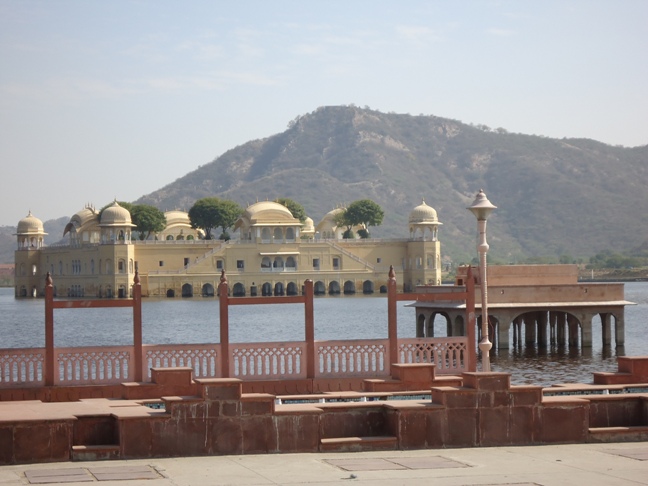
The morning after was a quite morning of introspection and I felt as though it was one of my girls who had been married off, especially since she was the first of my students to do so. We wanted to buy some camel leather juttis (embroidered slippers) so we checked out of the Rajputana and our designated driver took us to the motherlode near the Jal Mahal Palace on the outskirts of Jaipur. The Jal Mahal rests in an artificial lake/reservoir with a beautiful promenade.


The Jal Mahal (Water Palace) was built on the Man Sagar lake by Maharaja Sawai Jai Singh II. The Palace is beautifully lit up at night but alas we had no time to see that. The lake is a major waterfowl watching location with birds right from the Common Moorhen to the exotic Flamingo using these waters.

Opposite the lake are the Royal Cenotaphs of the ruling Kachwaha Dynasty of Jaipur.


On our way back we also visited a Jaipur mainstay - A Blue Pottery Centre, but were disappointed as this ceramic is now ubiquitous all over the Indian landscape and there were no new shapes or designs.


We finished our trip with a visit to a cotton cloth manufacturing centre to buy some typical vegetable dyed dabu bedsheets and ended up at our new hotel - the Suryaa Villa (which we had booked online via Make my Trip.com) behind the Moti Dungri Fort. It was a nice small, very economical, friendly and clean hotel. In fact it is more of a B&B than a hotel and the rooms are all named after various birds! I think we were in the Oriole.


Our room - spacious, clean, crisp linen, well aired with all the amenities and a nice view of the front lawn.


The most important thing about the room was the Bathroom - it was large (much larger than I expected), bright, well ventilated, with fresh towels and absolutely spotlessly clean and odour free!


Tucked behind the front building of the hotel  was a small courtyard with a sit-out coffee shop and 'pool' .... the coffee was standard but took 45 minutes to make an appearance (not that I or my book were complaining) and it drove Rhea almost to distraction.


The pool was really just a 12 foot by 12 foot tiled water tank! But nonetheless it was clean, full of water and a challenge only the criminally insane would have considered in the Rajasthan winter. The windowed room behind the pool was the restaurant where we had  a really nice dinner (simple food made hot on the spot) and a superb breakfast buffet (inclusive and unlimited) of toast, butter, jam, poha, scrambled eggs, bananas and cereal with milk, followed by tea/coffee. I'd recommend this place any day!


We spent the morning lazing in bed and then packed up and left for the airport and our flight back to (Navi) Mumbai.


Mumbai - which we were just as anxious to get to as we were loth to finish our holiday .... and the weather in Navi Mumbai a balmy 30 degrees C in winter as opposed to a high of 16 degrees in Jaipur!

Thank you Malvika and a big thank you to your parents.

Wednesday, May 25, 2011

Jaipur (22-24 Jan 2011): Part I

Jaipur is one of the prettiest and busiest cities in India and when my student Malvika told me she was getting married there and that I had to come - I agreed in a jiffy. Rhea and I had spent a couple of days in Jaipur, enroute to a Rock Art Society of India's Conference at Kotputli in the late 90's (during the early days of our courtship) and we were delighted to be going back. 

Malvika's dad had absolutely laid out the red carpet and we were whisked to Jaipur in a completely booked AI flight and put up at the ITC Sheraton Rajputana. It was the very lap of luxury and to top it off we were informed that the evenings function, the Sangeet. was in our very hotel. So we had a quick and amazing lunch at a Rajasthani Heritage Restaurant (I think it was the Ratan Haveli) where the Mehendi was in progress and  where we had such an amazing Rajasthani meal that we forgot to take a single picture! Anyhow we dressed up for the vening function and I just had to take a picture of Rhea. 


The next morning we had half the day to ourselves and a chauffeur driven car to drive us around so we set off for a Jaipur darshan tour to take in the sites and see the City Palace which we had missed the last time around. As we were walking the corridors of the Rajputana we looked outside the windows and saw a host of wild  peacocks and peahens busily strutting on the outer wall of the property.


From that memorable sight we moved on to take in the city. Our first destination on the way to the City Palace were the Moti Dungri and the Birla Mandir. The Moti Dungri is a small fortified palace modeled on a Scottish castle by Sawai Man Singh. It was later the abode of Maharani Gayatridevi and her son. 

The Birla Mandir also called the Laxmi Narayana Temple is one of three almost identical temples (the others are at Delhi and Calcutta) built by the Birla family.

It was a gorgeous winter morning and the blue skies were filled with small puffs of cloud.


We then swept through the bazaars of Jaipur on our way to the Hawa Mahal and the City Palace.


The Hawa Mahal (Palace of Winds) is the most famous icon of Jaipur. It is not really a palace but a set of multi-tiered verandas/jharokhas (windows) that were used by the palace ladies to look upon the bazaars and which were very well ventilated, especially in the Rajasthani summers. It is a unique building and we were happy to see it extremely well maintained. The last time we were here the paint was flaking and the insides smelled like a urinal.


The City Palace, which lies in a majestic large quarter behind the Hawa Mahal, was and is the abode of the erstwhile ruling family of Jaipur and was built by Maharana Sawai Jai Singh II who ruled from 1699–1744. The palace proudly flies the flag of the erstwhile state of Jaipur with a smaller pennant that flies above it whenever the royal family is in residence (see below - if you can). I was impressed with the Palace and was further impressed to find that the tour had small electric golfcarts available and that they were free for handicapped persons. 


We had an unforgettable tour and we visited the beautiful inner palace (clad in marble with exquisite carvings) which housed a collection of garments worn by the Jaipur Royalty of yesteryear. Sadly photography was banned everywhere within the City Palace museums. 


Details of the Balcony.


Details of the verandah.


More details!!


We had barely finished exclaiming when our golfcart driver took us to the next building where we saw the most comprehensive collection of arms both blades/projectiles and guns handheld and otherwise.

The entire complex is run by the royal family and their liveried retainers like the gent in the picture below. 


Two happy but gobsmacked tourists!


As we exited we saw a small doorway with a sign saying, 'The Palace Cafe', as you may have guessed we had to go. It was a beautifully laid out coffee shop with an extensive menu (but we had other plans for lunch) and we quickly ordered a coffee for Rhea and a Cold Coffee for me .... they were both very good. 


But what had us rivetted .....


... was a little tyke in traditional Rajasthani gear singing and dancing among the tables to entertain the guests.


More on Jaipur in Part II.
(The Sheraton Lunch, The Wedding and The Day After)