Sunday, June 10, 2012

Botticino at the Trident, BKC, Mumbai


Last month I had the incredible good fortune of being invited by my friend Nikhil (the Nonchalant Gourmand) to a lovely Pasta demonstartion and an exquisite Italian Lunch at the Botticino - the fine Italian restaurant (with a contemporary twist) at the Trident, BKC, Mumbai


The Trident at BKC is a lovely boutique-ish business hotel tucked neatly off but yet a stones throw away from BKC's main thoroughfare. It has a small but tall lobby with some rather eclectic modern art scattered in it. We got there a few minutes early and were gently ushered into the waiting area at the Botticino - their speciality Italian restaurant. The Botticino is open daily for lunch and dinner services and apart from its amazing menu and extensive wine list it boasts a premium and exhaustive selection of  Grappa. A selection of such variety and in such graceful and artistic containers that they have mounted these bottles onto a specially designed Grappa Wall!
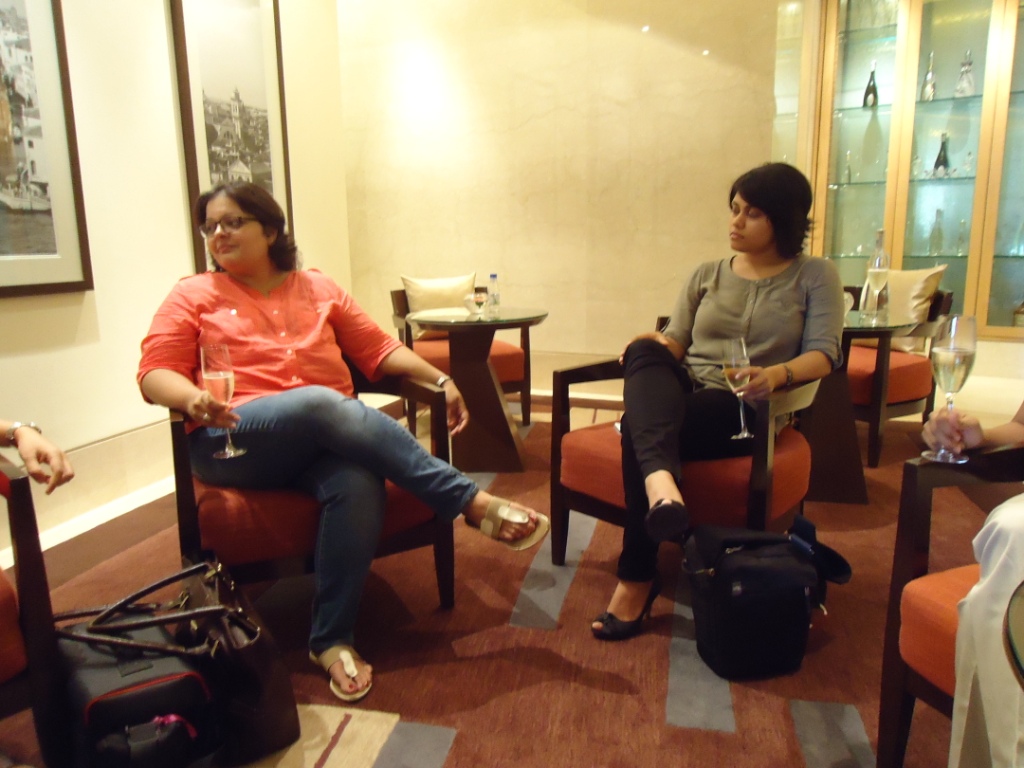

We were welcomed by Nikhil and Kainaz Daver (Communications Manager at the Trident) and plied with an exquisite Prosecco. Nikhil then told us that the days plan was to tour the restaurant, check out the kitchens, have a tete-a-tete with the Chef whilst he demonstrated how they make their own pasta and then a lunch where we could sample the offerings of the kitchen.


Salonee, Nikhil and Vrinda


Kainaz and Rhea


Grappa


More Grappa


Impeccably set tables.


Their famous floating table that hangs over their coffee shop (and where we were subsequently seated).


Clean classic white, crystal and silver service with a few pale pink roses and a lavender runner to add just that right bit of colour.


Their Bar.


The Kitchen with Chef  Vikas


The cold-kitchen where they assemble the salads and garnishes.


Megha and the crustacean tanks.


Chef Vikas (probably wondering what all these crazy bloggers would end up doing!!) the main man in charge of the Botticino's kitchen and menus.


Kainaz, probably wondering why they need to chain their fridges!


They keep their wine coolers chained and padlocked ... I guess mere fridge locks are child's play to the denizens of the kitchen.


Their quirky but lovely tea/coffee service.


Rhea, Saee and Vrinda looking quite cute in their caps.


Chef Vikas demonstrating how dough is put together - the first step in making any pasta. 


The dough resting.


Flattening it out through a pasta-maker.


Making ravioli.


Contents of the Pasta Fridge 


Making sauce, boiling pasta and assembling the Chicken Ravioli in Mushroom Sauce.


The finished dish.


(It was yumm!)


The Bloggers assembled at their table - ready to eat.


Delicious Ciabata bread fresh from the Trident's own bakery - served with pureed bell peppers.


The amuse bouche: Chef's very own take on the classic Mozzarella with sliced tomatoes.


Sea-salt encrusted Lavash.


The Argula, Pear and Pecorino Salad.


As an appetiser I chose the Pan-grilled  Foie Gras, it was truly sensational; soft, flavourful, perfectly cooked and very well complimented by a reduced red wine sauce. make sure all you Foie Gras lovers make the most of this as there is a move to ban its production.


For my Mains I chose the Herb encrusted Snapper with an Orange sauce, thinking it wouldn't hold a candle to the appetiser ... boy was I wrong, and very happily so, even if I say so myself. The fish was cooked to absolute perfection, soft flaky, firm, translucent and so fresh that it felt like it had been caught just that morning. The slightly sweet and tangy orange sauce was the perfect foil to the crusty saltiness of the fish. The only slightly puzzling feature were the cubed potatoes and carrots which appeared to have been placed there keeping in mind the Indian fixation with them. I for one would have perhaps preferred a steamed spinach. 


The Herb crusted Snapper with an Orange sauce.


Chef then came out to see that all was well and to bask in the absolute admiration of the gathered bloggers.


We rounded up the meal with Chef's signature dessert - A triple scoop of ice-cream on a white chocolate strip with a dark chocolate curl. The ice-cream flavours were an eclectic choice. We were served (from left to right) a Starcciatella - which was good; a Lemon cheesecake - that was mild and understated; and a Salted Caramel - absolutely the perfect blend of creamy chewy sweetness with small explosions of salt. 

The Salted Caramel ice-cream was a sure winner and I'd shamelessly recommend that if you like ice-cream you should go here just to eat this. 


At 4.30pm a very happy bunch of well fed and satiated bloggers slowly waddled their way out of the Trident promising themselves that they would be back.

The Botticino at the Trident was truly all that it claimed to be. It might be a trifle fussy and frou-frou, it might be a wee bit more than just expensive ... but it was worth it.


Tuesday, May 22, 2012

Excavations at Chandore 2012


 Introduction
The Ancient Temple complex at Chandore (18 09’ 52” N; 73 11’ 02” S) is situated near the hamlet of Chambharpada at Chandhore Village, Tal Mangaon, Dist Raigad, Maharashtra. The site was discovered in 2011 by a joint team of members from the Centre for Extra-Mural Studies (CEMS), University of Mumbai and the India Study Centre (INSTUCEN), Mumbai. These explorations were carried out in March 2011 (Dalal 2012). (See earlier post fromMay 2011)

After explorations it was decided to apply for permission to the Archaeological Survey of India to conduct archaeological investigations (both excavations and clearance) at the site in the 2011-2012 Season. The CEMS applied in conjunction with the India Study Centre Trust (INSTUCEN), Mumbai.  Permission was granted and the excavations carried out under the direction of the author along with the past and present students of the CEMS.


The Site

The ancient site of Chandore is located less than half a kilometer to the east of the modern village of Chandhore opposite (and to the west of) the hamlet of Chambharpada. This site is essentially a cluster of Temples/Temple Plinths and lies close to the medieval coastal port site of Mhasla and the other medieval port sites on the Rajapur Creek.


It is also located along the very road that leads from the interiors of Maharashtra to the Rajapur creek and eventually the coast. It is equidistant from Goregaon and Mangaon and would have been the convergence centre for the routes from the north (via Mangaon) and south (via Goregaon) flow of traffic of goods from the interior to the ports of the Konkan. It thus lies on a critical node of one the most viable trade routes in this region.


The ancient site itself is made up of a complex of temples/temple plinths and assorted structural and sculptural members. The plinths in turn can be divided into 2 sub complexes – divided by the Chandore-Govele road - the first opposite the Chambharpada and the second about 100m to the west of the Chambharpada. The first group/complex of temples includes a single large disturbed plinth with an adjacent tank/step well with a smaller temple and nandimandapa. The second group/complex (north of the first group and west of Chambharpada) consists of at least two more temple plinths (one intact and exposed and the other buried and only partially exposed) and a host of smaller structure bases and scattered sculptural members.


The Excavations
The excavations per se were carried out on the eastern side of Complex1 - Plinth 1. Two quadrants each measuring 2.5 x 2.5m were taken up for excavations. The reason for the location of the trench was the slope and the possible accumulation of debris due to the obstruction of the natural flow of rain borne soil and artefacts by Plinth 1. 


The excavations revealed a very small deposit between 30 and 70cm. the soil excavated was uniform and no real layers with the exception of humus discolouration were visible. The bedrock (laterite) locally known as kaatal was exposed in both quadrants. A large number of potsherds of coarse Red and Grey wares, bangle fragments of glass, a broken wound (black) glass bead, a fragment of Monochrome Glazed Ware – a West Asian import (a second example was found whilst clearing the debris on the steps of the tank), a silver Gadhaiya coin (Maheshwari 2010: 83, Cat No. 204-244) and a large number of retouched stone tools (microliths) and tool making debris were recovered from the trench.


The bangles are mainly opaque black with a few green and fewer blue/bichrome blue examples. Amongst the large number of bangle fragments are few with coloured appliqué glass dots reminiscent of similar bangles found at Sanjan (Gupta et. al. 2003; 2004) and dated between the 9th and 12th c AD.

The microliths are a separate and unique ‘problem’. To the best of the authors knowledge these are the first microliths excavated in a stratified context in the Konkan. They require a serious and dedicated study and will be dealt with separately and in detail at a later stage.

Suffice to say that the microliths take back the antiquity of human occupation at Chandhore to at least the 2nd millennium BC.

Conclusion
In conclusion, the sculptural material, the hero/sati stones, the pillars and the Gadhaiya coin all point out to a 10th to 13th c AD period for the site. The Monochrome Glazed Ware and a few very specific types of decorated glass bangles point to a slightly later terminal date of approximately the 15th c AD.

All these conclusions are preliminary and much more work is needed to ascertain the facts.


Acknowledgements
The excavation at Chandhore was carried out by the Centre for Extra Mural Studies, University of Mumbai in partnership with the India Study Centre Trust (INSTUCEN), Mumbai.

I am very grateful to the Archaeological Survey of India; the Vice-Chancellor, University of Mumbai; the Director of the Centre for Extra Mural Studies, University of Mumbai; Mr. Samuel Nazareth, Dr Aravind Jamkhedkar, Dr Suraj Pandit and Dr Abhijit Dandekar.

Special mention must also be made of Dr B. Vaidyanathan who almost single-handedly created the detailed site plan for the first season of excavations.

I am also indebted to the staff at the department, all of my students past and present who participated in the excavations and the labourers and villagers of Chandhore for all their help and patience.


And finally, my sincerest thanks to Siddharth Kale, Tukaram Kadam and Andre Baptista for being the pillars on whom I could lean with effrontery.