Wednesday, May 16, 2018

In defence of the 'Adopt a Heritage' scheme


File:Delhi, Red Fort (6258220875).jpg

The last few days have seen a huge uproar in the media and on social media regarding the Government of India (GoI)’s scheme to allow Corporate Houses to adopt Heritage sites both Cultural and Natural.

This is my attempt at defending the governments stand. At the onset let me lay down my cards, I am a trained archaeologist and teach archaeology at the University of Mumbai. I have also consulted with a company desiring to adopt some of the heritage that the Ministry of Culture would like adopted.

The huge hue and cry in the media has been that the GoI has given away these heritage structures to multi-national and mega corporate house since they are unable to take care of India’s Heritage, that this is a ‘saffronised’ plot to re-write history, that this is a blatant giving-up of responsibilities and that it is a slap in the face of tradition and history and an insult to all those people who lived, died and strove to make these monuments what they are.

The secondary allegations are against the Dalmia Groups credentials on Heritage Management and Conservation and also some unnecessary slander of a personal familial nature.

Let me start by asking all those concerned to take a deep breath and to sit back. Please peruse the documents related to the scheme. This scheme is a revamped version of an older scheme first proposed by the last government in power. At no point does the scheme give away the monument. The monument per se and its conservation continue to be in the very safe hands of the Archaeological Survey of India (ASI). No adopting agency can in any way interfere with this. Point two the adopting agency is responsible for cleanliness, security, sanitation, drinking water, ticketing, lighting, park furniture, disabled access, Wi-Fi, Audio Guides,  and a visitor’s centre. They may also be allowed to set up a food and beverage concession and a gift/souvenir shop. The ticket amount goes right into the coffers of the ASI. Any money generated by the adopter is put into a specific account and all profits have to be funneled right back into the monument adopted.

This will allow the ASI to concentrate on what it does best i.e. taking care of the Heritage aspect of the monument. It will also take a huge load off the ASI’s shoulders regarding the nitty-gritty of non-archaeological and non-conservational matters. It should be noted here that the landscaping will still be strictly in the hands of the ASI.

Shah Jahan's iconic Red Fort in Delhi is now Dalmia Bharat group's Red Fort said the Business Standard, this is a typically ‘click-bait’ type of headline with a terrible lack of any reading of what is actually happening and virtually zero due diligence. No it isn’t theirs and they haven’t ‘bought it for 5 years for 5 crores a year’. They have been allowed, note allowed, to adopt the monument and their yearly spend for the 5 year period is pegged at 25 crores i.e. 5 crores per annum.

Now should we debate this? Yes we should. It is our right to do so in a democracy and debating the pros and cons will only make our democracy and the scheme stronger. Should we go off shouting how horrible it is without looking into? No, that would be plain foolish.

Thus debating the Heritage credentials of the company doing any of the adopting is quite pointless, debating their management skills would be a good idea.

Why do I think it’s a good idea? The first reason is because our heritage desperately needs help. The second reason (this will hurt a few toes) is because the government and its agencies take loads of time to do things, they are cumbersome, have complicated cumbersome mechanisms and the smallest cog failing can result in months if not years of delays. The corporate world in that way is the antithesis and will get done what needs to be done when it needs to be done and in the most cost effective way possible. The comparison between the overworked suburban railway systems in Mumbai vis-à-vis the privately run metro is a glaring example of this.

Added to the above reasons is the fact that many an Indian Corporation does (contrary to public belief) care about the nation’s heritage and would love to give back a little something to it. Why are we hell bent on denying them these rights? They have the funds and are willing to use them under the very strict guidelines and supervision of the ASI and the responsible ministries. Give them a chance. The GoI has very clearly maintained that they can and will immediately pull the rug if the corporate sponsors don't follow meticulously the guidelines. Let’s be the pubic watchdogs and keep them in line!

And what about the heritage conservation skills of the adopters? Well they don’t need to have any, they have to take on an empanelled Conservation Architect and even after that the monument per se is completely off limits. Thus their experience in conservation of ‘built heritage’ isn’t even really a question.

What do the corporates get out of this? They get satisfaction, pride and bragging rights. They also get their logo on a board outside the monument, on one corner of the tickets and inside the toilets.

So let’s breathe a little easy and take stock of the situation and calmly proceed.

(Image from: https://commons.wikimedia.org/wiki/File:Delhi,_Red_Fort_(6258220875).jpg)


Saturday, April 14, 2018

14th April 1944: The day that WWII came to Bombay

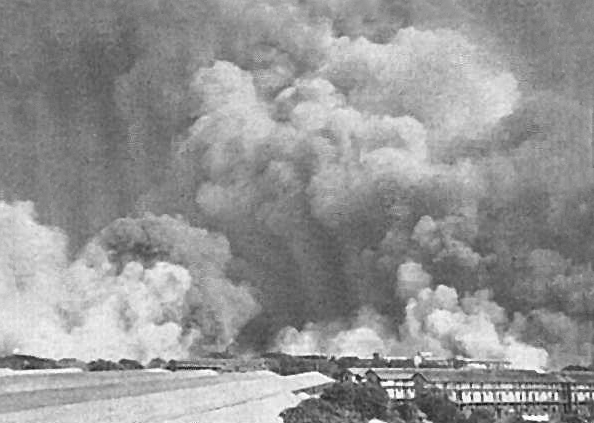
At 3.50 pm on 14th April 1944 my grandfather Hirji Rustomji Dalal was seated in his Navy jeep next to his driver at the Dhobhi Talao junction casually smoking a cigarette on his way to Her Majesty's Docks at Lion Gate when the air quivered with a massive shockwave that blew apart the glass facade of the Metro theatre. The shockwave was followed by a tremendous noise. My grandfather looked at his driver and said, "To the docks now!". He reached a scene of utter and complete devastation. South Mumbai was overhung with clouds of black smoke.


Bombay-Docks-aftermath1.png

Pic from Wikipedia (https://en.wikipedia.org/wiki/1944_Bombay_explosion#/media/File:Bombay-Docks-aftermath1.png)

The SS Fort Striknine had just blown up in Bombay Harbour, the shock-waves were felt in Simla(!) and windows blew out of their frames in a two kilometer radius from the docks. Shrapnel from exploding ships, buildings and other ordnance flew all over the city and along with it flew bars of gold which were a part of the cargo. One of these bars flew through the sky before crashing through the roof of the bathroom of a Parsi gentleman having a bath. The gold bar slammed into his bucket of water where it sizzled for some time. I still remember his son telling me how hard he laughed to see his naked, soap covered father running out of the bathroom. He said it was worth the subsequent spanking. They recovered the charred bar and it was recognised for what it was. He returned it to the athourities, for which he received an honourary title and was known as Khan Bahadur henceforth. Later almost all the gold was recovered by the British though a few bars keep turning up every few years during the dredging of Mumbai Harbour.


    Pic from the Mumbai Mirror 02/022011 (http://epaper.timesofindia.com/Repository/getFiles.asp?Style=OliveXLib:LowLevelEntityToPrint_MIRRORNEW&Type=text/html&Locale=english-skin-custom&Path=MMIR/2011/02/02&ID=Ar00100)

My mother's grand uncle Mr Sohrabji Frenchman used to work in the docks, that fateful day he had finished his shift and was almost outside the gates when he remembered he had forgotten his tiffin, he went back in and was never seen again. The family searched amongst the dead bodies stacked like cordwood in the aftermath but to no avail. I can still see the look of horror on my maternal grandfather's face as he recounted this tale to me more than 30 years later.

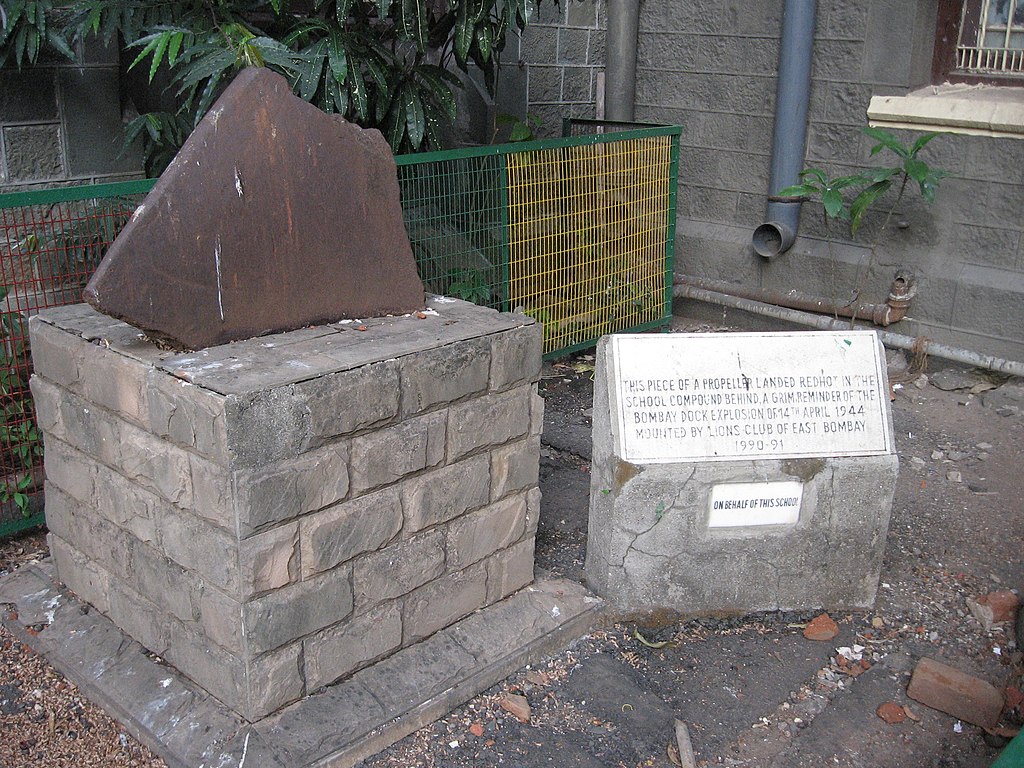
For the next fortnight my grandfather only came home to bathe and change said my dad who had his own story to tell. A huge propeller fragment flew from the harbour over 2km away to fall in the compound of his school, St Xavier's High School, Fort. It is still there on the school campus and I I remember my dad showing it to me when i followed him to do my schooling there. I also proudly told my classmates about it and how my dad was in school when this huge chunk of iron landed there!


Pic from Wikipedia (https://en.wikipedia.org/wiki/1944_Bombay_explosion#/media/File:1944_Bombay_harbour_explosion_propeller_piece.jpg)

There were many tales of great courage shown that day and in the next few days most of which were never recorded. The people of the city hid in Victoria Gardens (now the Jijamata Udyan) at Byculla, many left the city forever. Many a family was traumatised and many lost loved ones. The death toll was pegged at 1300 of which over 500 were civilians and 66 were firefighters (memorialised forever after in a memorial which stands outside Mumbai Fire Brigade HQ at Byculla even today). 14th April has been celebrated as 'Fire Services Day' in India since that day.


Pic from Wikipedia (https://en.wikipedia.org/wiki/Mumbai_Fire_Brigade#/media/File:Mumbai_Firefighters_Memorial.jpg)

One of the most interesting notes in the war office is one recording the amazing service of the Bhikha Behram Well near the Churchgate Station. For seven days and seven nights the docks burned and for seven days and seven nights fire tenders continuously pumped water from the well which miraculously didn't go dry.


Pic from cityseeker.com ((https://cityseeker.com/mumbai/395998-bhika-behram-well)

No one has still determined whether this event was an accident or sabotage. But it left an undeniable mark on Bombay for all time.


Monday, August 14, 2017

My name is Pateti and I am no one's New year!


Around this time of the year I begin to dread the sound of the words 'Happy Pateti' or 'Pateti Mubarak' trilling off the mouths of friends, well wishers and others. With every such occurrence something inside me cringes and dies a small death. I have even had the word mangled and voiced as Papeti! A papeti is a diminutive papeto, Gujarati for a small/baby potato!

I have decided that this year I have to finally do something about it ... this just cant go on!


Most non-Parsis and to my complete open-mouthed amazement even a few Parsis think that the Parsi word for New Year is Pateti. Let me lay down the law for all of you here. The correct word for New Year or New Year's day is Navroze, and the correct greeting is Navroze Mubarak

So then where does this word Pateti come from? 


Pateti is the last day of the Parsi year. The day before Navroze. It is not a day of celebration but a day of intense introspection and a day when you go over your deeds of the last year and repent those that you realise did not conform to the Parsi credo- Good Thoughts, Good Words, and Good Deeds. A day you make amends with your self and your Maker, and promise that you will do better in the coming year. This may be done at home or at a fire temple. Many an old school Parsi will go to the local Agiary to do this.

The devout Parsi thus performs Patet on this day. He/she accepts his/her shortcomings, shows a readiness to accept the judgement for the same, and most importantly makes a resolution not to make the same mistakes in the coming year. 

Thus unburdened of these misdeeds you make a fresh start with the next day and the New Year - Navroze! 

And just like Good Friday and Moharram you don't wish someone on such a day.

So this year do it right, wish your Parsi friend a Happy Navroze.


Navroze Mubarak to all! And may this year bring you peace, prosperity and happiness.


Tuesday, July 18, 2017

The Parsis - 3 different calendars and 4 'New Year' days

A lot of my friends have been asking me how its Parsi New year today when the calendrical event is supposedly still 30 days away. This post is a small attempt on my part to clear the murk.

The Parsis of India are the descendants of a group of Zoroastrian refugees who fled Persia some time in the 9th century AD and took refuge on the mainland of India.

The descendants of these refugees are called the Parsis and they are concentrated (today) mainly in Mumbai, Pune, Ahmedabad, Surat, Delhi and Hyderabad. Their biggest contingent of resides in Mumbai and makes up almost 70-80% of the Parsi population of India. There is also a considerable overseas diaspora.

Amongst the many quirky things about this small group of (less than 50 thousand) people is the fact that they celebrate three different days of the year as their New Year Day. There are two very clear subgroups the Shehenshahis and the Kadmis (there is also a smaller group called the Faslis but more on them later).

The original Zoroastrian calendar in Persia was supposedly created by their mythical king, Jamshed. He decried that the year (a solar year) would begin on the Vernal Equinox. This day was therefore called Jamshedi Navroze. On most years this day (when day and night are of equal duration) falls in the northern hemisphere on the 21st of March. On leap years it falls on the 20th. It may also (very rarely) fall on the 19th of March ... this has to do with the computed time slippage of 5 hours 49 minutes per year. Those of you who are astronomically challenged will need to ask Google to sort this out for you.

The Parsis of India continue thus to celebrate the Vernal Equinox as Jamshedi Navroze (Jamshed's New Year) it is an important date in the calendar but it doesn't mark the first day of the Parsi Calender. They celebrate it as an auspicious day and because the Parsis will jump at any excuse for a celebration.

The Parsi calendar is a continuation of the Sassanian Calender of Iran. The last Sassanian emperor was defeated in 642 AD by the Arabs and they installed the Hijri calender in its place. The Sassanian calender consisted of 12 months each of 30 days. To these 360 days of the year were added 5 additional days called the Gathas. This made up a 365 day year. The Persians realised the slippage and calculated that they needed to add 25 lost days each century. So they created a ceremony and a month called the Kabisa where a leap month of 30 days (according to some oral traditions every century a leap month of 25 days plus the the 5 Gathas) was added to the year. This would then sync the year with the solar rhythms.

The add to the confusion the year itself was dated to the beginning of the reign of each monarch and was a Regnal year date. When Yezdegird Sheriyar III (the last Sassanian Emperor) was defeated at the battle of Nehavand he was in his 10th regnal Year, the calendar having commenced from the 16th of June 632 AD. This calendar is still followed in Persia and is known as the Qadmi/Qadimi/Kadmi calender. The Kabisa was never officially performed after the death of Yezdegird.


(A silver coin of Yezdegird Sheriyar III - image from Wikipedia)


The Parsis of India on the other hand have a calendar that is exactly one month out of sync with the Persian calendar. Their Navroze falls exactly one month after the Kadmi Navroze. They call their calendar the Imperial Calendar or the Shehenshahi Calendar. The suffix YZ to their year.
This discrepancy was realised by them when they were confronted by it in 1720 AD when an Iranian Zoroastrian priest called Jamshed Velati traveled to India and pointed this out to them. Apparently the Ancestors of the Parsis had performed a single Kabisa and thus the calendar was out of sync by a month. Many Indian Zoroastrians thought they should follow that which was being followed in Iran and converted to this calendar the majority though refused. This led to a rift and two parallel calendars now became current. This resulted in a split in the clergy with separate fire-temples for both groups. For a some time there were no marriages between the groups though now this is no longer true.

In the early 20th century Kharshedji Rustamji Cama (after whom the K R Cama Oriental Institute is named) decided to try and reform the Parsi calendars by proposing: 1. A 365 day calendar with the provisions for a leap year and 2. A commencement from the Vernal Equinox i.e. on Jamshedi Navroze.
It was immediately adopted by a few Parsis but was rejected by the majority as the Orthodox priests refused to switch. Surprisingly the Iranian Government made the same changes in Iran and adopted a new calendar that starts on the the day of the Vernal Equinox! It was called the Fasli (Harvest) calendar. There are few adherents of the Fasli calendar and only a single fire-temple at Churchgate in Mumbai.

Legend has it that the official shift to the Fasli calendar was proposed to the Mumbai Parsi Panchayet (the apex governing body of the Parsis of India) which decided to vote on it. The proposal lost out by one single vote and doomed the community to yet another calendar.

Thursday, April 13, 2017

Of Failed meetings and Fine Food - Lunch at Malvani Aswad.


A few weeks ago an old friend asked me to do an old friend of hers a favour. What was the need of the hour was an archaeologist to speak to a group of visiting researchers. They were looking for an anthropologist but since none was available at short notice would I sub and help out? I wasn't doing much the next day so I said yes. Sent my CV in which was promptly forwarded to the researchers. The meeting was scheduled for the next afternoon at 1 pm ... at 12.30 as I was enroute I received a panicked call asking me if I would speak briefly to the leader of the research team. I said yes and there followed one of the weirdest telephone conversations of my life. It consisted of questions as to my ability to answer questions each of which was followed by the questions 1. Are you an anthropologist? and 2. Would you call yourself an anthropologist? All the routine questions got the correct answers but I replied negatively to the Anthropologist queries which were becoming very repetitive and weird. 

I reached the meeting place in Vile Parle E in Mumbai and was met by a very flustered friend of friend. Who apologised profusely and told me that thee meeting was scrubbed and that the research team was off to lunch. They hadn't realised that my CV didn't say anthropologist(!) and that they couldn't discuss the topic with me as their principles had specified that they were to talk to an anthropologist! I was ready to throw a fit when I realised that the lady organising this wasn't to blame and was terribly uncomfortable to boot. She apologised profusely, showed me printouts of her emails (including my CV) and an affirmative call by the team. She was almost in tears and I thought "what the hell let it go" and proceeded to do so. In an interesting twist she insisted on remunerating me in full as it wasn't my fault in any way (her words). I was tickled and decided to treat myself to lunch.


As I left the building I remembered a small Malvani restaurant highly recommended by my friend, food blogger extraordinaire, Kalyan. Its a small hole in the wall joint called Malvani Aswad and the only restaurant I know that is shaped like an elongated parallelogram with a kitchen in its loft. It has no A/c and no loo but the simple (very clean) restaurant is always packed with diners.

True to its reputation it was packed to the gills with about 20 people waiting to get in and another 8-10 waiting for take-aways. This is always a good sign in the food business. I was offered a plastic chair on the footpath and I sank into it and pulled out my Kindle. 15 mins later I was asked to place my order and told my table would be ready in 10 minutes and so would my lunch. i decided to go with the Kombdi Masala served with Vade. In other words a chicken in a thick yellow brown dessicated coconut gravy redolent with  roasted spices served with deep fried puffed breads called Vade. Vade are a bit like puris but thicker and coarser giving you a lot of texture as you eat them. And just to be a bit of a glutton I asked for a side of fried Surmai (Seer).


Ten minutes later I was shown to my table and a minute later my lunch was before me. The Chicken was everything I hoped it would be and the Vade were delightfully crunchy. The fish (a large slice) was fresh, succulent and well coated with Malvani spices. A small bowl of a thinner curry (with the teaspoon in it) and another of Sol Kadhi (Coconut milk and Kokum extract), lime wedges, onions, a very nice and super fresh chutney also came with my lunch. The food was spicy yet not chili hot and the Sol Kadhi was there to soothe the mouth in between bites. It was one of the best Malvani meals I had had in quite a few months.I heartily recommend this restaurant. thank you Kalyan for directing my footsteps and stomach this-a-way.

But I wasn't yet finished with lunch. Sitting outside I'd spied an ice-cream freezer loaded to the gills with a variety of things amongst which was a blast from the past. An ice-cream from my childhood days called a Cassata. This was a slice cut from a hemisphere or roll of multiple ice-creams (traditionally strawberry, pista and tutti-frutti) spread over a base of cake and topped with nuts. I hadn't eaten one of these in many years and I just had to cap this awesomely great lunch with an epic dessert and I asked the gent at the ice-cream freezer to do the honours.


Some time later sated and very happy I wobbled out of Malvani Aswad with a second helping of chicken for R's dinner (and as a peace offering for having gone here without her).


Highly recommended folks, Malvani Aswad is at Shahaji Raje Road, Near Bhuta High School, Parle Colony, Vile Parle East, Mumbai 
Tel: 022 2684 5842 Open 11 am to 3 pm and then 7 to 11 pm


Wednesday, March 8, 2017

Pitnaik's Chikki Shop, Revdanda


Wandering through the by-lanes of towns and villages in the Konkan during Archaeological Explorations one comes across some truly unique and beautiful gems. These are often not just palaces or archaeological monuments but small quaint pieces of the heritage of the Konkan, its people and its foods. One such gem I stumbled across in the small town of Revdanda (17 km south of Alibaug), erstwhile Portuguese fortress and home to one of the oldest Bene Israeli synagogues whilst doing a quick field trip in search of Bene Israeli remains with my wife Rhea and my student Raamesh. 

Searching for the synagogue we parked at the mouth of the lane leading to it and as we stepped out from the car in front of us was a chikki shop with a name I had never encountered before. Intrigued I went in to find an old gentleman selling squares of chikki and fudge. 


Chikki is a very Indian version of brittle, the main difference is that whilst brittle has a few nuts or butterscotch in it chikki is mainly nuts held together with a caramelised jaggery. Whilst the most common chikki has either whole or crushed peanuts in it there are many other variants. Common variants include roasted gram (chana), shredded coconut (khopra), amaranth (rajgira) and toasted sesame seeds (til). 

Pitnaik's had crushed peanut chikki, sesame seed chikki, shredded coconut chikki and squares of coconut fudge (khopra paak) white and a ghastly orange. You can see some of these squares in the pic below, each square was priced at the princely sum of Rs 5/- (less than 8 cents US!). There was just one packet of the uncoloured fudge which I promptly ate thus no pic of the same.I refused to buy the violently coloured one.


(Top left - Coconut, top right - Sesame, bottom - Crushed Peanuts)


I have been to Revdanda probably 20 times if not more I wonder how I missed this little shop all these years. Had it not been for our quest for the Bene Israeli synagogue we'd never have found this gem. The chikkis were really nice and I will drop by next time I am there and recommend the same to all of you travelling the Konkan, these little businesses need all the help they can get.

Revdanda Fort is a true wonder of colonial fortifications with hidden facets peeping out from under creepers and vines and there is an absolutely fabulous beach hiding here. Across the Kundalika River is the Fort of Korlai which gaurds the mouth to the river alongside the Revdanda Fort and it has spectacular views of the sea and Revdanda. Revdanda lies on the route from Alibaug to Murud and makes for a great stopover.

The Emancipation of Parvati Kadam

Parvati Kadam was affectionately known as my mother's dowry. As a very young bride she came down to Mumbai to live with her (much older) husband who worked in the BPT.  She was trained by my maternal grandmother in her Bandra kitchen ... on wood, coal, kerosene wick, kerosene pump and gas stoves ... a skill set almost completely missing today. She would cook, clean and feed my gran's entire household and was soon a master of Parsi cuisine.

When my Mum married my Dad and moved to VT in 1968 she came along to help Mum and stayed on for the next 25 years. She was almost a second mum to me, she doted on me and packed my lunch and on rare days even came over to drop me to school. But this is not about how she took care of me but about how she ultimately took care of her own demons. 

Very often she would come home to work in the mornings with a swollen face, black-eye or bruised arms. When I asked her she would say she had fallen at home. My mum used to get incredibly worked up and would tell her not to put up with this but to make a Police complaint and that mum would stand by her. Mr Kadam a by and large nice gent used to get a bit drunk once in a while and on those days he'd come home and toss her around. After much screaming by my mum she'd quietly reply that it was okay after all he was her 'maalak' (Marathi term for husband whose literal translation is owner)! This would incense my mother even more.

Over the years the beatings seemed to lessen especially as Mum had started her catering business (KFD Caterers) and Parvati was her strong right arm and Chief Cook. She was bringing home the bacon in sizable chunks. 

Then one day Mr Kadam came to see my mum he must have been in his early 60s and he looked much the worse for the wear ... swollen faced he requested my mother to speak to Parvati. When my mother asked him to clarify he said she had been coming home and once a while whaling the tar out of him! He was most embarrassed at what the neighbours were saying about a wife beating her husband.

The back story to this was that as she got a little longer in the tooth and the business scaled up there would often be late night after late night with catering for 500 to a 1000 persons each day. At the end of the day there would be a tired lot of kitchen staff that would send out for something to fortify themselves with and the tipple of choice was Doctor Brandy. A couple of nips and she would go home by cab (courtesy Mum) ... and on arrival sometimes give it back to her husband with full interest.


My mother was least sympathetic and chortled with glee ... when she had finished laughing she told him it was simply payback for all he had done and that as a good Indian he should think of this as his karma.

On this 'Women's Day' I cant think of a better memory.

Thank you Parvati for all your love and care.


Friday, February 12, 2016

Wine Wednesdays at Maritime by San Lorenzo

A couple of weeks back Rhea asked me if I'd like to go to a Wine tasting evening at the Taj Land's End in Bandra and I very happily jumped to it. The event is called the Wine Social Wednesday and is held at the Taj Land's End's lovely Italian restaurant the Maritime by San Lorenzo.

We got there at 7.30 pm and were met by the PR Team and Ms Rajveer Kaur who put us at our ease and explained the background to this weekly event. The idea was to introduce the wines of Italy (and elsewhere) and pair them with Chef Allessandro's really simple but amazing Italian food. Knowing that they had a superior wine selection they also knew that the Indian wine drinker was a hesitant careful creature not very open to experimentation. So they came up with an idea where they would not only make a selection of their wines available by the glass instead of the bottle, but they would also showcase the low price point that was one of their USPs . The restaurant has decided to pass on the benefits of the good rates they are getting from their purveyors - a real winner for wine lovers in Mumbai!

They had a lovely selection of Whites and Reds all priced incredibly well. We started off with a Prosecco that was a lovely well rounded yet young tasting wine. Low in acidity, very fruity and not too sweet. With this the Chef sent out a lovely basket of Gamberetti and Calamari Fritti (Crumbed Fried Prawns and Squid rings).

We moved on to a really complex yet full bodied Saint Clair Marlborough Sauvignon Blanc from New Zealand. Very few people in India seem to even know about the absolute world class winners that come out of the vineyards of New Zealand. Both Rhea and I have always been very partial to the Waipara Springs Reisling thanks to our friends Sue and Imtiaz and are always game to try out a New Zealand wine. The Saint Clair Marlborough did not let us down at all. With this Chef served up his really interesting variation on a Focaccia ... a flat, thin and somewhat crisp focaccia with arugula and shaved Parmesan and truffle infused olive oil. I am a self confessed carbo-holic and I was very pleasantly surprised by this.  Chef Allesandro told us this was a Focaccia Tartufata and was a memory from his childhood in Italy. We asked him what else he could do with this and he sent out an absolutely fantastic variant (off the menu) topped with Parma ham, shaved Parmesan and his truffle infused olive oil. It was magnificent, truly Buonissimo!


I decided to try out one of their red wines and went in for the Chilean Trapaca El Rosal Pinot. I have learnt to have a very healthy respect for South American wines and have found them to often be finer than their Californian counterparts which are often more flash than flavour. I love my wines young and fruity, with a little body, not a great deal of tartness/acidity nor mouth puckering tannin or an excessively long finish. I know that wine enthusiasts are probably going to call me a barbarian but I like my wine young, fruity, with flowery and/or citrus-y notes, a well rounded body and a good finish. The Trapaca Pinot was all of this. I for one was truly happy and Chef's Calzone was a perfect accompaniment. I can recommend this wine to all comers - first timers, old hands and rebels.


Chef wouldn't let us go without dessert and he brought the evening to a fantastic end with his selection - an apple tart, a silken tiramisu and a heavenly pear and raisin 'pie' his mother used to make.

The wines are priced extremely well and 'by the glass' prices range between INR 400 and 700. The place has a lovely feel to it and their selection of both wine and food is truly charming. I'd really recommend this mid-week indulgence especially around Valentine's Day.


Monday, January 18, 2016

The Land of Stone - An International Conference and a truly awesome Dakkhani meal!


Sometime in November 2015 my close buddy Abhijit told me about an International Conference being organised on the Pre-Colonial Deccan in Gulbarga in Jan 2016. So I jumped to it and demanded to be let in. The man organising the conference at the Central University  Karnataka (CUK) was the indefatigible Dr Nazrul Bari. he wrote in to me inviting me and I happily accepted. I was looking forward to meeting historians and others of my ilk in a place I had never visited before but which was in the top half of my bucket list of places to visit!

Gulbarga, today renamed Kalaburagi (kalla=stone + buragi=land in Kannada), or The Land of Stone was the original capital of the the Bahamani Sultanate formed when Hasan Gangu captured Daulatabad after Md. bin Tuglaq had abandoned it. 


Tuglaq had moved the whole of Delhi to the Deccan to centralise the capital of his Indian empire ... a brilliant idea but one he was unable to maintain. Hasan Gangu or Zafar Khan (as he had been renmaed by Khilji  was appointed governor of Daulatabad. According to one legend Hasan Gangu was the Turkic slave of an astrologer from Delhi called Gangu (Gangaram), another legend says he was actually a Brahmin who converted  to islam and hence named his dynasty after his previous caste affiliation - Bahmani! 

He ascended the throne with the regnal name  Abu'l Muzaffar Ala-ud-din Shah Bahamani and founded the Bahamani Sultanate in 1347AD. He was a bit vary of Daulatabad and its lure and moved his capital to Gulbarga where he built a beautiful fort. The Gulbarga Fort with its squat round bastions, stocky bartizans and oversized crennelations is the prototype of the Bhamani style of defence architecture and the precurcessor of almost all the defence architecture in the  Deccan for the next 400 years. The thick rounded bastions with bartizans offering a secure position for defending archers was a Turkish innovation and the style of architecture employed was also of Turkish or Saracening origins. The Bahamanis employed this with absolute aplomb and ensured virtually impregnable fortresses. The sucessors of Hasan Gangu soon spread outwards and soon the sultanate expanded. In 1425 Ad the capital was moved to Bidar. it was from the safety of Bidar that the Machhiavellian Primeminister Mahmud Gavan expanded the empire by reconquering Goa from the Vijayanagara kings.

Gulbarga was by then an inescapable part of the Deccan or Dakhan and has its own flavour of Urdu called Dakkhani as well as its Sufi mysticism thanks to the famous Sufi saint Khwaja Bande Nawaz.

I arrived at Gulbarga on the morning of the 13th of Jan and was picked up by a very courteous Md Rafique sent by Nazrul. He took me over to the Central Park Hotel where a lot of old friends from Deccan College were waiting for me. Abhijit, Ganvir, Joge, Guru and his wife Reshma were all present as was Tejas ... after a quick breakfast we were off to CUK. The Univ is about 25km away from the heart of Gulbarga and has a sprawlingly large modern campus. Nazrul and his able team of student volunteers had put together an absolutely lovely Conference. After the usual inauguration function we got down to the academic sessions. My paper was titled ' A Preliminary Report on the Medieval excavations at Chandore 2012-2015' was in the first session and was recieved very well. The rest of the day flowed into session after session and there were some amazing papers by old friends as well as a number of new folks (to me atleast). Abhijit Dandekar, Gwendolyn, Gopal Joge, Shrikant Ganvir, Reshma Sawant, Gurudas Shete and so many others read some really lovely papers.


After a full day Md rafique took us back via a friends tea shop where we had some of the finest meat and chicken samosas I have eaten. These looked just like the ubiquitous Punjabi samosa but were stuffed with nonveg goodness. The meat (read 'buffalo') samosa had a coarse mince flavoured with spices, mint and a touch of dill. The chicken samosa was a revelation. The filling was tiny cubes of chicken breast cooked to perfection in a simple onion, garlic and blak pepper base. 

That night we went off to a dinner hosted by the Conferences patron - the Karnataka Minister for Minorities. The food was nice but what sang in the entire meal was the Gulbarga version of Khubbani ka meetha (stewed dried apricots). 

Day two of the conference started with us taking off a bit late and on the way we spotted the outer walls of Gulbarga Fort. This was too good a chance to miss and we played truant from the conference for the next half an hour by asking our driver to take us around the firt. When we got to the main entrance he surprised us all by driving right in! The fort is still tenanted by a few families who claim decent from its original denizens. Inside was a slightly sad sight. The Gulbarga Jama Masjid was in good nick as was the central bastion ... the rest was in a sorry and dilapidated state. This mosque at Gulbarga is the greatest example of the Persian style of architecture and stands testimony to the master architects of the 14th c AD.


We raced off to CUK and to our surprise arrived just as the first paper of the days first academic session started! The day then proceeded in a whilwind with presentations by Tejas Garge, Abdul Aziz Rajput, Danish Moin, Rekha Pande and Anne Feldhaus amongst many many others. The day came to an end with a simple valedictory function where the VC of CUK announced the creation of a full department of History and Archaeology! Nazrul had pulled off a fantastic event.


Abdul Aziz Rajput speaking on Bahamani Architecture


Danish Moin speaking on Bahamani Coinage and its secular nature


Dr Rekha Pande delivering a very interestalk on the Tawaifs of Hyderabad


Dr Nazrul Bari wrapping up the Valedictory function

Abhijit and team left early that evening leaving tejas and me to fend for ourselves, We soon teamed up with Prof Ayub of Hyderabad and went of in search of the famous Gulbarga sweetmeat the Maal-Puri from the famous Mama Puri Mithai shop. Md Rafique came to the rescue and led us through a maze of small lanes to the treasure.

After dropping off Prof Ayub, Tejas and I asked Md Rafique to take us to eat at a place where he would and he took us down the lane from Bande Nawaz's Dargan to a small eatery called Nawaz!


The menu was limited to four main courses (actually just two) Gravy Chicken or Mutton and Biryani once again Chicken or Mutton. We orderd the Chicken Gravy with Rumali Rotis and one each of the Biryanis.

The chicken was cubed and boneless (to my surprise) but with a slightly punchy, smoky, creamy gravy with a soft silken texture. It had nuances on so many levels it surprised the hell out of me. The rotis were thin but soft not dry and went perfectly with the chicken. 


The Biryanis came next. Md rafique had very proudly proclaimed that this wasnt just the best in Gulbarga but better than any Biryani from Hyderabad. A claim that surprisingly was spot on. The Mutton Biryani was subtle, the meat soft and pink inside, the rice fragrant, separate but not dry, it was a Biryani of sublime proportions. It was served with a thin Curd raita and a kick-ass Mirchi ka salan. The Chicken biryani was completely different it was full of a fried onion birasta coating the succulent chicken (thankfuly on the bone) pieces that nestled in long grain rice cooked to perfection. The three of us were glubbed when the waiter suggested very strongly that we have dessert. When asked he said the options were (you guessed it!) two - Khubbani and Froot. We had had the Khubbani the previous nite so we opted for the Froot. I didnt expect much, boy was I overwhelmed. We got a very very subtle fruit salad with custard variant where the fruits had spent some time soaked in a mildly sweeted heavily reduced milk rabri. The milk had thickened further on being sucked in by the apples and the milk-macerated fruits were a sensual delight in the mouth. They put out the fires f the biryani and overlaid a gentle blanket of sweetness.


Chicken Biryani on top left Mutton on bottom right

.

The Froot!

We gently rolled out of Nawaz after paying a bill of Rs 692/-!


Later at the Hotel, Tejas and I contemplated moving to Gulbarga. Especially after Md. Rafique had regaled us with tales of a divinely inspired Nalli Nihari sold from 4.30am onwards outside the Dargah of Bande Nawaz which he swore was better than any other takers. After the biryani boast we were wont to taking him very seriously and I have promised I will be back to Gulbarga if not for anything else then for this. 

Tejas left for Aurangabad via Ahmednagar at midnite and I slept like a log till 7.45am ... when I rolled out of bed and almost directly onto the train to Mumbai.

Gulbarga left a mark on me, on both my academic interests and my palate, both far larger than I had expected. thank you Nazrul and Md Rafique and thank you Abhijit for roping me in.


Saturday, August 22, 2015

Tadi No Batervo ... Mutton cooked in Palm Toddy

Every year on Khordad Sal (the birthday of the prophet Zarathushtra) we try to make something a bit left of centre for our clients be they traditional Parsi recipes from rural Gujarat, Continental favourites or long lost classics. This year Rhea decided she was tired of Continental and she wanted us at Katy's Kitchen to give the Parsis (and food lovers) of Mumbai a chance to take a journey deep into the Parsi kitchens of rural Gujarat 50 or more years ago. So with serious determination writ on our faces we went to the cupboard and yanked out the two volumes of Katy Dalal's  Jamva Chaloji. I chose the Tadi no Batervo and she chose the Murghi no Khurmo (more on this in some other post). 

I was completely enamoured by the prospect of cooking mutton in a reducing base of Palm Toddy  and we decided to bring this heirloom recipe to our patrons and friends. I remember my mum speaking about this dish and how it was made in her great-granpa Kanjibhai's house in Tadgam (near Nargol in Gujarat). He would ensure that one of his Warli boys got down a pot of sweet morning toddy at 5 or 6 am before the sun got to accelerating the fermentation process. He would also chose a tree that had been recently tapped as this would make a difference she said. There is a huge history to this dish Katy in Jamva Chaloji 2 tells us that Valsara Fooa made this (at Mamakwara) for Lady Navajbai Tata when she visited Nargol to review the Tata-Wadia School and even many years later she said it was the best meal she ever had.

It's a very simple dish, mutton is marinated in a green masala made with chillies, corriander, mint, ginger, garlic, pepper and cloves. It is braised in hot oil and then submerged in sweet toddy and brought to a boil.It is cooked on a low flame and toddy is topped up as and when required till the mutton is finally cooked. It takes at least an hour and a half to cook, the slower the tastier...if you can cook on a wood fire in a terracotta chattie it will taste even better. The gravy should be sticky and have a mildly caramelised feel to it. 

Tadi no Batervo is best eaten with hot white rice or rice rotlis. It is a very simple dish but with complex flavours. There is a mild sourness coupled with sweetness yet both sour and sweet are unlike the usual such tastes and the green masala adds a subtle underlying note of spice. 


The Mutton and the Marinade


The Marinated mutton and the Sweet Toddy


Braising


Adding the Sweet Toddy


The finished Tadi no Batervo

Wednesday, August 5, 2015

Usmanbhai - Last Engineer of the Rim World


Day before yesterday me and Lara (my Bullet Thunderbird 325) decided to make the most of a rainfree day and chug down to the University. It was cloudy, cool and perfect driving weather. Chugging down NH4 - cool wind in my hair, warm smell of diesel dust wafting through the air ... I was almost unhorsed by the sudden appearance of an unholy pothole. It was small, sharp edged, deep and almost perfectly rounded. We bounced through it and I knew instantly that something was amiss. We rolled off the Vashi flyover and lo behold! there was a huge dent in the front rim. If I had been driving any other bike we would have come to a nasty stop at the pothole itself and as Vinodbhai, Bullet specialist at Kalina told me, if I had opted for magwheels the front rim would have snapped clean through. Truly they build these bikes to last.

The tube was sound and after a wait of a few minutes when I saw that the air pressure was holding I decided to risk it and make a run for the Univ. We rumbled all the way. At the Kalina petrol pump I asked for a Bullet mechanic and was told to meet Vinodbhai in the adjacent lane. I did so. he turned out to be a very amiable middle aged fellow who took one look at the bike and said, "samajh gaya bhai kuch bolne ki zaroroorat nahin (I've understood it no need to say anything)". He then told me that I had two options - replace the rim or have it straightened out by an expert. I asked him if he would undertake to do it? He said he could but preferably I should go over to Usmanbhai at Bandra reclamation since all he (Vinod) would do was take the wheel over there anyways. He gave me directions and a cell number and I agreed to take Lara there after work.

We slowly rumbled over at 6 pm and I found Usmanbhai in a tiny little shack off the main road at the foot of the fancy roundabout flyover at Bandra. To find Usmanbhai's you need to take the loop to SV Rd but at the end you take the arm that goes to reclamation and not the one that descends in front of Bandra masjid.

Usman why was a jovial gent with salt and pepper hair and a matching stubble. He took one look at the rim and put me at ease by telling me not to worry, and that I was in safe hands. They (he and his man Friday) popped off the wheel in five minutes flat (not a mean feat considering this was the front wheel of a Bullet) and a few minutes later Usmanbhai was expertly removing the tube, tyre and the disk-brake disk.

That he was a master was apparent from the first move he made. His skill at taking of the bolts on the disk whilst telling me not to worry (as there was a silca compound added whilst putting them on the first time and that this made things difficult but not impossible) while he was slowly loosening the bolts put me at ease. Here was a man who obviously knew what he was doing. He then took off all the spokes whilst giving me a running commentary on the 'good luck' that I wasn't running Lara on magwheels and that I obviously was an old timer at riding since I hadn't even taken the slightest fall after doing this kind of damage to the wheel. After taking a wooden mallet to the wheel rim to 'starighten it out he proceded to add the spokes. Usmanbhaithen placed the wheel on a special jig and proceeded to gently 'true' the wheel by adjusting the spokes (ie tightening them). He further informed me that all Bullets needed spoke tightening after the first 4 to 6 months and that I should get the rear wheel seen to later.

I could see the rapt concentration as he heard and felt his way around the rim. It was slightly uncanny, he'd use sight, sound and feel to check repeatedly on the rim. After almost half an hour and a few gentle taps to get rid of the last bumps on the rim he spun the tyre in the jig and lo it spun with no wobble whatsoever! I was truly impressed.


We  got to talking and he told me that this was his forte and that he had been doing this all his life. He reminisced about the early days in Bandra when Parsis and Christains brought their cycles to him esp the ones with gears and brakes in the rear drum and that there was no one else for miles who knew how to 'trough' a cyle wheel like that, Usmanbhai went on to work art the Rajdoot factory and there he was in charge of wheel assembly, he then decided to go it on his own and came back to Bandra and set up shop. Today he is the No. 1 man for Bullet rims, spokes, drums and he also extends his expertise to other bikes. He fondly told me that he was the man in Mumbai for double spoking and for straigtening out rims for Bullets. Double spoking is doubling the number of spokes on the wheel with thinner spokes, the drum needs to have new holes expertly drilled and then it needs to be re-spoked. Usmanbhai not only does the spoke fitting but also drills his own holes, no mean feat considering the precision required. He very quietly said that all the Bullet ustaads (experts) and mechanics of Mumbai know him and if they want quality work they come only to him.

I was so happy to have been a part of his world even if it was for a couple of hours. To see a man of his skill and experience, doing something that in any other country would have been done by  a bevy of machines or most probably where the damaged part would simply have been replaced without a thought.  It is people like Usmanbhai who keep alive the traditional karigiri something so essential in lifting a craft to an art. I salute these men and women who toil on doing their thing with expertise and quiet dignity.

Lara and I drove of from Usmanbhai's with no wobble at all and a smile on our faces.

P.S. due apologies to Larry Niven for the pun in the title :)

Saturday, July 11, 2015

Raanachya Bhajya - The Forest Greens

I have heard a lot of complaining these days about the monotony of Indian vegetables and the variety of foreign veggies ... I have heard cribbing and complaining with no real action. Have even 10% of urban Indians bothered to find out what vegetables are available? No. There are tonnes of Indian vegetables and we just need to go out there and make a little effort.

Added to this in the last few years have been my discoveries of what are called raanachya bhajya or forest greens eaten all over Maharashtra in the Monsoons. Traditionally summer is a time for stored, dried beans and dals and the monsoons, before the longer growing vegetables are ready, are the time for foraging and eating fast growing and freshly sprouting vegetables from the forests, field boundaries and the charai (grazing) lands.

My fascination for these took off with the 'shevaal'  (Amorphophallus commutatus) that I saw sprouting at my excavation site in 2012. These would be quickly appropriated by the first labourer to see one. Shevaal is a great favourite along the Konkan and is cooked with mutton mince or with dried prawns ... Kunda Maushi makes it amazingly well and she showed me how the stamen is to be removed and discarded and how the shoot/flower needs to be soaked in salt water otherwise it leads to a very itchy throat. My friend Soumitra Velkar also posted a shevaal recipe  which reminded me that I must keep an eye out for the shoots this monsoon. 


Image Credit: http://www.indianaturewatch.net/images/album/photo/1121821107466becf31f5ef.jpg


A few days later my friend and colleague Dr Suraj Pandit came over to the University for a meeting and his lunchbox had a vegetable I had never seen or heard of before ... gentle probing led to the interesting story of a vegetable to be eaten at least once a year in the monsoons (supposedly for its therapeutic values according to Ayurveda) called  Shatavari. It was slimy, chewy and faintly oniony till you got a grip on the leaves which, when crushed tasted quite unique. You won't have me clamouring for it but I wouldn't turn it down either.

When I asked our senior resident botanist Dr Lattoo he laughed and told me I was eating wild asparagus - Asparagus racemosus . I realised when I googled it that the damn thing used to grow wild in a pot on my balcony for years!


The third wild veggie I ate this month was a real surprise I hadn't eaten it in years and had only heard my friend Rushina say they were sometimes seen in Grant Rd Bhaji Galli - fiddlehead ferns. They are a great treat in Canada and Canadian friends regularly post pictures on Facebook ... but I was pleasantly surprised to hear that they are a rage in Bengal, Assam, Nepal and parts of the Northeast. The Bengalis call it dhenki shaak and the Assamese call it dhekia xaak.

We'd gone over to Gitika's for an amazing Assamese tribal meal last week and lo behold! She had made Pork with Fiddleheads! Needless to say much happiness was derived.


Image Credit: The Sassy Fork


As I was driving to work yesterday AIR FM 100.7 had a lovely programme in Marathi in the afternoon around 1pm which was discussing these veggies ... there were at least 25 different veggies they named and they advised new cooks to ask the old 'maushis' selling them for cooking tips. What a lovely yet simple way of keeping tradition alive.

So if you think there isn't enough variety in vegetables just visit the smaller neighbourhood markets and look around for things you don't recognise. And take the plunge!